

The conversations nobody teaches you how to have

This Golden Hour Aging guide is for the adult child in the middle: the sandwich generation carrying parents, children, and a career at once. It covers the conversations that decide how aging goes in a family, why they get avoided, and why structure, not willpower, is what makes them possible.
The feelings are normal. Nobody says so.
Read what caregivers write at midnight and the same words repeat: drowning, guilty, resentful, invisible, exhausted. Not one of those people lacks love. They lack a structure that shares the weight, and they have usually been compensating alone for so long that the compensation itself has become invisible to everyone else.
So I’ll say it plainly: not wanting this job doesn’t make you a bad son or daughter. It makes you a person carrying a role nobody designed, in a family that never decided who does what. That’s fixable, and it isn’t fixed by trying harder.
Why do families avoid the aging conversation?
Because everyone is protecting everyone. Parents avoid it to spare their children, and to keep the version of themselves that doesn’t need help. Children avoid it because raising it feels like an accusation, or an invitation to something everyone would rather not name. So the family waits, and the conversation finally happens in a hospital corridor, on the worst possible day, with the fewest possible options.
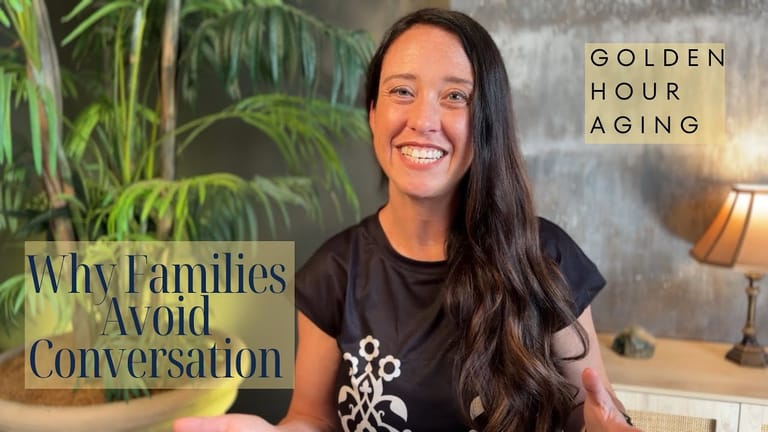
The alternative isn’t one brave talk. It’s small, early, factual conversations, anchored to something concrete: a checklist, a document, a score. It’s easier for a family to argue about a score than about a feeling. That’s why the assessment produces a number. My video below is a good place to feel the shape of it.
What about the sibling doing everything, or nothing?
Sibling conflict over a parent’s care is rarely about the parent. It’s about unshared information, undivided labor and unspoken history, arriving all at once. The pattern that works is boring on purpose: get the facts shared first, divide the work by ability rather than by geography or guilt, and put the decisions in writing so nobody re-litigates them from memory. The full guide to that conversation is on this topic’s list below.
This gets easier when everyone can see the same facts
Every conversation on this page gets easier when the family has a shared picture of where the parent stands. That’s what the Protocol’s assessment is for, and it’s why the gentlest first step is usually the free Stability Brief: it puts the situation on paper, and paper is something a family can sit down and look at together. When the conversations themselves are what’s stuck, the supported pathway is there for exactly that: four one-on-one sessions where I work through them with you.
This is planning and organization guidance, not medical, legal, or financial advice. Decisions about care, medication, and legal documents belong with your parent’s clinicians and your own attorney.

Written by Stephanie Drobny, RN, MS-HSL, CPHQ, LSSGB Nurse executive, founder of Golden Hour Aging. Written September 2026 · last reviewed September 2026.
Questions families actually ask
What’s the sandwich generation carrying?
Two dependent generations at once: children still at home, parents beginning to need help, and a career in the middle. The practical load is real, and the invisible load is heavier: being the researcher, scheduler, advocate, and worrier for people in both directions, usually without anyone having decided it out loud.
Why is this harder than people expect?
Because nobody plans for it. There’s no start date: a fall, a diagnosis, or a slow accumulation of small things, and one adult child is suddenly the default. By the time the load has a name, the patterns are set, and changing a set pattern in a family takes more than good intentions.
What helps, and what doesn’t?
What helps is structure: naming who does what, deciding things before they’re urgent, and putting the facts where everyone can see them, because most family conflict in caregiving is really conflict about unshared information. What doesn’t help is trying harder inside a structure that’s broken, which is what burned-out caregivers have usually been doing for years.
Where do you start when everything is urgent?
By getting clear about where things stand. That’s what the free Stability Brief is for: it turns the fog into a picture, and a picture is something a family can finally discuss.
Coming in this topic
Suggested by the families this library serves, including my own viewers and readers. Each gets its own full, bylined guide:
- When a parent refuses help
- Sibling conflict over a parent’s care
- Setting boundaries with aging parents
- Talking about the future before it arrives
- Long-distance caregiving
- Caregiver burnout: the real symptoms
- Estrangement and caregiving
- Caregiving versus caretaking
- When your own health is failing too
- The standard of zero: caregivers who must need nothing
- Working with doctors, nurses, and aides
- Supporting them without losing yourselves
Related reading: the checklists · the videos.
Start with the free Stability Brief
A guided self-assessment of how much strain your family is carrying as a parent ages, and what typically comes next. Free, by email, no obligation.